Deutsch
 English
 Französisch
 Polnisch
HOW CUT-RESISTANT IS A PROTECTIVE GLOVE REALLY?
Sharp edges, tools or materials with rough surfaces: many tasks expose hands to a variety of mechanical hazards. The cut resistance of protective gloves is particularly important when handling sharp-edged objects.But how can we determine how resistant a glove material is to cuts? Various standardised test methods are available for this purpose. One of these is the Coupe test according to EN 388.
But how does the Coupe test work, what do the results tell us and how does it differ from the TDM test?
HOW IS CUT RESISTANCE TESTED USING THE COUPE TEST?
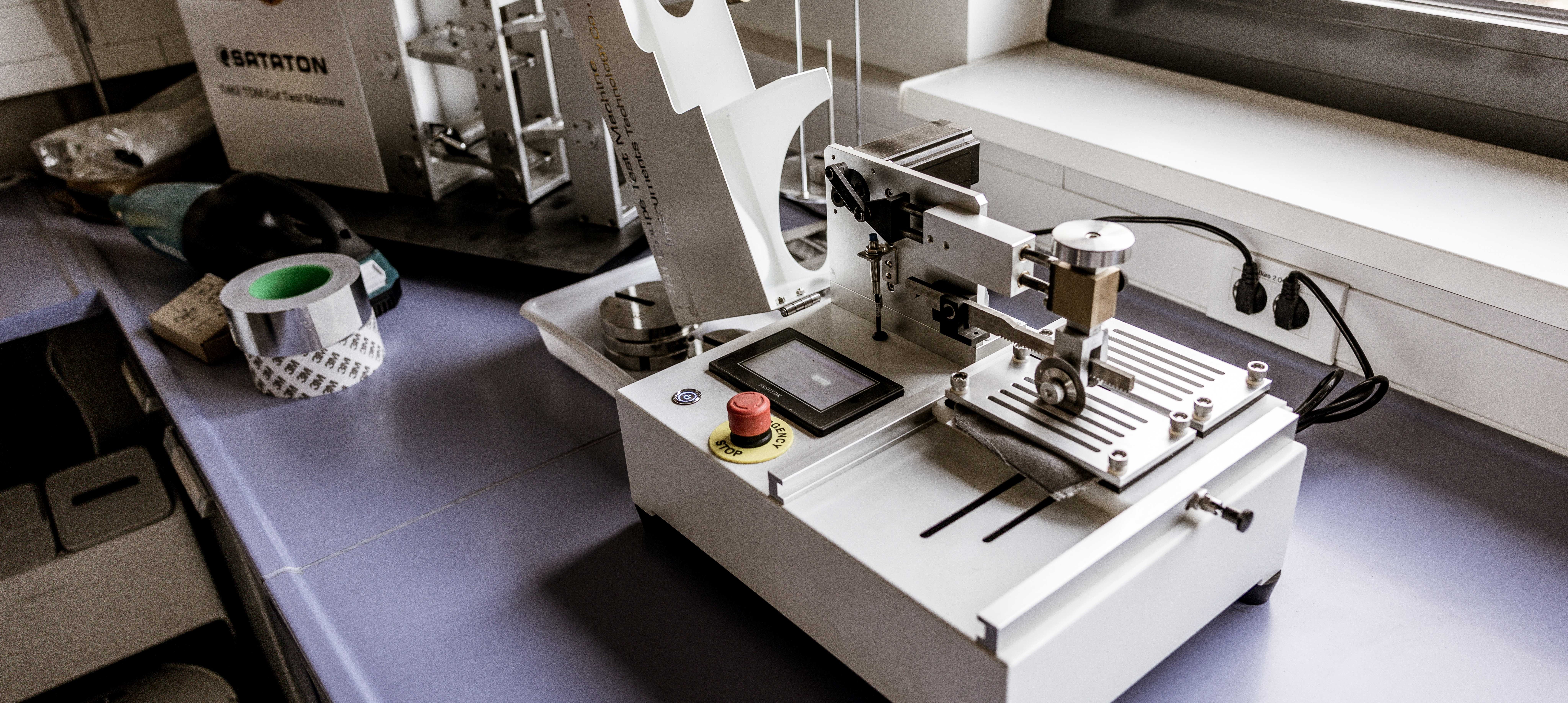
The Coupe test is a test method used to determine the cut resistance of protective glove materials according to EN 388. A rotating circular blade repeatedly moves across the material under a constant load.The test determines how many cutting cycles are required to cut through the material. A specified reference material is also tested to allow the results to be evaluated.
The testing procedure at a glance:
+ Preparation: The glove material to be examined is prepared for testing and positioned in the testing device.
+ Cutting movement: A rotating circular blade repeatedly moves across the material under a defined load.
+ Cut-through: The number of cutting cycles required to cut through the material is determined.
+ Evaluation: The results are compared with measurements taken using the reference material and used to determine the cut resistance index.
Based on this index, the material is assigned a performance level from 1 to 5. The higher the level achieved, the greater the cut resistance determined by the Coup test.
| Performance Level | Cut Resistance Index |
| 1 | ≥ 1,2 |
| 2 | ≥ 2,5 |
| 3 | ≥ 5,0 |
| 4 | ≥ 10,0 |
| 5 | ≥ 20,0 |
The performance level is indicated in the second position of the EN 388 marking. It provides a standardised classification of cut resistance under the specified test conditions.
COUPE TEST OR TDM TEST – WHAT IS THE DIFFERENCE?
In addition to the Coupe test, the TDM test is another method used to assess cut resistance according to EN 388. Both examine a material's resistance to a blade, but differ in their testing procedures.While the Coupe test uses a rotating circular blade that repeatedly moves across the material under a constant load, the TDM test uses a straight blade. This method determines the force required to cut through the material over a defined cutting distance.
The key differences at a glance:
| Coupe Test | TDM Test |
| Rotating circular blade | Straight blade |
| Repeated cutting movements | Individual cutting movements |
| Constant load | Varying cutting forces |
| Assessment based on cut resistance index | Assessment based on the cutting force required |
| Performance levels 1–5 | Performance levels A–F |
An important difference becomes apparent when testing particularly cut-resistant materials. These can cause the blade used in the Coupe test to become blunt during testing, which may affect the result.
If significant blade dulling is detected, the TDM test result is used to assess cut resistance according to EN 388. In this case, the Coupe test is marked with an X. The two methods therefore complement each other when assessing different glove materials.
Want to learn more about the TDM test? In our blog article on cut resistance testing using the TDM method, we explain the testing procedure and performance levels A to F in more detail.